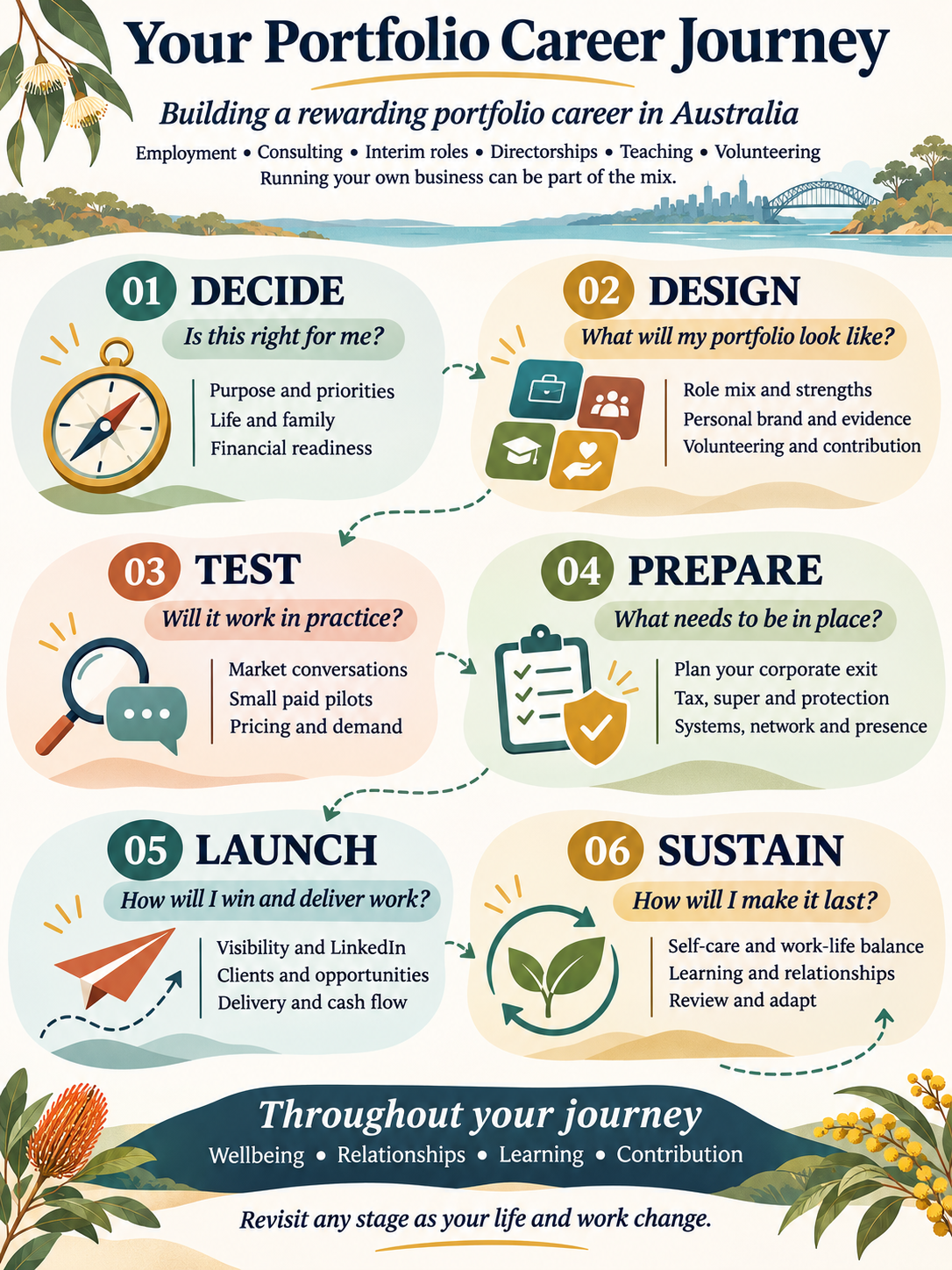
The six stages of a portfolio career

From deciding whether a portfolio career is right for you to making it last. Each stage below covers what it involves, a few things worth knowing, and one exercise you can try this week.

Illustrated journey board titled Your Portfolio Career Journey, showing the six stages Decide, Design, Test, Prepare, Launch and Sustain linked by a dotted path, with wellbeing, relationships, learning and contribution running throughout.
Revisit any stage as your life and work change.
1

Decide

Is this right for me?

Understand what a portfolio career could offer, and whether this is the right move for you now.

What it covers

Purpose and priorities
What you want to move towards, what you want to leave behind, and what you would miss about corporate life: identity, status, belonging and a team around you.
Life and family
What success means for income, contribution, flexibility, time and relationships, and the expectations of the people the move affects, including caring responsibilities, location and travel.
Financial readiness
Household spending, commitments and reserves, the cost of leaving employment, and the benefits you will need to replace.

Worth knowing

  • A portfolio can start with a planned pivot, a gradual transition or a redundancy. Each needs a different plan and timeline.
  • Allow for paid work starting later than you hope, invoices being paid late and holidays being unpaid. Agree in advance when you would pause, adapt or take employment alongside the portfolio.

Try thisBuild three household scenarios: an expected start, a slow start and a prolonged gap in income.

Questions 1 to 3 of the readiness questionnaire look at Decide. See where you stand on all six stages.

Check your readiness
2

Design

What will my portfolio look like?

Choose a mix of work that uses your strengths and supports the life you want.

What it covers

Role mix and strengths
Employment, projects, retainers, fractional and interim roles, teaching and boards, balanced for anchor income, variety, purpose, capacity and risk.
Personal brand and evidence
What you want to be known for across each part of your portfolio, backed by outcomes, recommendations and case studies rather than your last job title.
Volunteering and contribution
Causes that matter to you, skills-based volunteering and governance roles, with realistic limits on unpaid time.

Worth knowing

  • Revenue, profit and personal income are three different numbers. Time for sales, administration, learning and the gaps between assignments is unpaid, but it is still part of the job.
  • If a directorship is part of your plan, you must apply for a director ID before you are appointed, and you can apply up to 12 months ahead. Australian Business Registry Services

Try thisMap your proposed roles against income, time, flexibility, purpose and risk, then ask what happens if you lose your largest assignment.

Questions 4 and 5 of the readiness questionnaire look at Design. See where you stand on all six stages.

Check your readiness
3

Test

Will it work in practice?

Find evidence that your work is wanted, affordable for buyers and worthwhile for you, before you commit.

What it covers

Market conversations
Target sectors, decision-makers and the problems they need solved, and how they buy. Encouraging feedback is not the same as a buyer with a reason and a budget to act.
Small paid pilots
A diagnostic, workshop or short project that tests delivery effort and the buyer's experience, while respecting your obligations to your current employer.
Pricing and demand
Day rates, fixed fees and retainers compared against the value to the buyer and the full time involved, including preparation, revisions and travel.

Worth knowing

  • Decide before you start what evidence would justify proceeding, adapting the offer or pausing, and keep the option of staying in or returning to employment.

Try thisPlan one small test with a clear question, a time limit and the evidence you will collect.

Question 6 of the readiness questionnaire looks at Test. See where you stand on all six stages.

Check your readiness
4

Prepare

What needs to be in place?

Put the relationships, capability and practical arrangements in place for a sound transition.

What it covers

Plan your corporate exit
Timing, handover and how you explain the move, plus outside-work permissions, confidentiality, intellectual property and any restraints in your contract.
Tax, super and protection
Business structure, ABN, GST, BAS and PAYG instalments, personal services income, superannuation and insurance, with professional advice where you need it.
Systems, network and presence
IT, accounting and contact tools, secure handling of client information, a map of your network, and the executive presence to influence without a title.

Worth knowing

  • You must register for GST once your business's GST turnover reaches $75,000 a year, and within 21 days of reaching it. ATO
  • Income earned mainly from your personal skills or effort is personal services income, and special tax rules can apply to it, including when you work through a company or trust. ATO
  • As a sole trader, no one pays super guarantee for you. Personal contributions are your choice, and you may be able to claim a tax deduction for them. ATO
  • Check whether leaving employment changes any insurance you hold through your super fund. Moneysmart

Try thisList each income stream you expect and note the registrations, obligations and advice each one needs.

Questions 7 and 8 of the readiness questionnaire look at Prepare. See where you stand on all six stages.

Check your readiness
5

Launch

How will I win and deliver work?

Make your portfolio visible, secure work and set up reliable ways of delivering it.

What it covers

Visibility and LinkedIn
A profile, short biography and evidence that match your new direction, with a realistic routine for sharing ideas, asking for recommendations and reconnecting.
Clients and opportunities
Turning relationships into discovery conversations, proposals and clear agreements, through referrals, recruiters, interim providers, consulting partners and tenders.
Delivery and cash flow
Clear scope and milestones at the start, invoicing on time, following up late payments, and asking for case studies, further work and referrals at the end.

Worth knowing

  • Keep business development going while you deliver, or the end of your first large assignment can leave an empty pipeline.
  • Use AI to help with research, administration and drafts, but in ways that keep your own voice and judgement, and with your clients' permission where their information is involved.

Try thisBuild a simple pipeline of potential work and rehearse a discovery conversation with a prospective buyer.

Question 9 of the readiness questionnaire looks at Launch. See where you stand on all six stages.

Check your readiness
6

Sustain

How will I make it last?

Build a way of working that stays financially sound, personally rewarding and sustainable.

What it covers

Self-care and work-life balance
Boundaries, holidays, quiet periods, rejection and isolation, and keeping your income separate from your sense of self-worth.
Learning and relationships
Capability gaps found through real work, mentors and peer groups, and keeping your network watered rather than visiting it only when you need something.
Review and adapt
Regular reviews of income, pipeline, workload, enjoyment and contribution, then deciding what to grow, reduce, renegotiate or stop.

Worth knowing

  • Watch client concentration: a portfolio that depends on one client or one market carries much of the risk of a single job.
  • Stress-test the portfolio against losing a client, two deadlines clashing and time away from work through illness.

Try thisComplete an energy and time audit, then compare your actual week with the one you planned.

Question 10 of the readiness questionnaire looks at Sustain. See where you stand on all six stages.

Check your readiness

Throughout your journey

  • WellbeingHealth, recovery and support before difficulties build up.
  • RelationshipsFamily, peers, mentors and the network that opens doors.
  • LearningNew skills, qualifications and practice, for life.
  • ContributionThe work and causes that make the portfolio worthwhile.

This page is general information only, not financial, tax or legal advice. Talk to your accountant, financial adviser or lawyer about your own situation.

Which stage are you at?

Answer 17 questions about where you are now. Paul reads every response and sends you a 1-page Portfolio Readiness Assessment showing where you stand across the six stages, with an invitation to a free 30-minute call.

Start the questionnaire

About 10 minutes. Your answers are only seen by Paul.